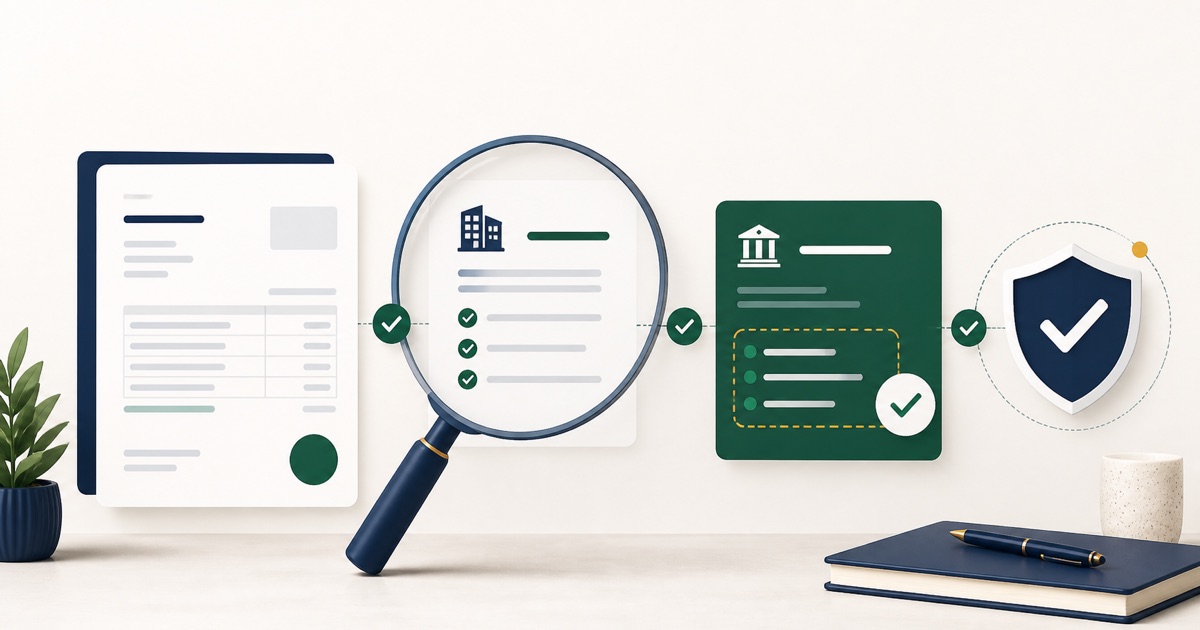
Before paying an invoice, verify the legal company, the request and the payment destination separately. A CRO company search can confirm valuable public-register details, but it cannot prove that an email, invoice or bank-account change is genuine.
The safest habit
Never use contact details supplied only in the invoice or a “new bank details” email to verify that request. Call a known contact using a number sourced independently, and use dual approval for material payments.
Search the exact Irish legal entity
Begin with the legal company name or CRO registration number on the invoice. A trading name may not be the incorporated entity you are contracting with. Similar names can also point to a different company, so match the CRO number and registered office as well as the name.
For a holiday deposit, verify the Irish travel business’s licence or insolvency protection as well as its legal identity. A CRO record cannot confirm protection for the actual booking.
What the public company record can verify
Public CRO-derived information is useful for identity and due diligence. It can help you check whether the stated company exists and whether the invoice name is plausible. It cannot authenticate a payment request.
| Check | What it can help establish | What it cannot prove |
|---|---|---|
| Legal name and CRO number | The incorporated entity you intend to deal with | That the sender controls the email or bank account |
| Registered office and status | Public register information and company identity context | Trading address, delivery location or live solvency |
| Officers and filing history | Further identity and compliance context | Authority for a particular invoice or payment instruction |
| Accounts and charges | Historical due-diligence information | Current cash position or invoice validity |
Invoice-payment verification checklist
- Match the contracting party. Check the legal name, CRO number, VAT details where relevant, order reference and address against your approved supplier record.
- Check the commercial evidence. Confirm the purchase order, delivery, timesheet, contract milestone or goods-received record.
- Verify the sender independently. Use a known website, signed contract, previous verified contact or another independently sourced route.
- Separate the bank-detail check. Treat a changed IBAN or account name as a new instruction requiring a call-back and internal approval.
- Check the amount and urgency. Unexpected urgency, changed wording or a request to bypass controls should trigger escalation, not faster payment.
- Keep an audit trail. Record who checked what, when and through which independent contact channel.
Why bank-detail changes deserve a separate control
Business-email compromise can make a genuine supplier email thread look convincing. A correct company name and invoice format do not prove that the bank account in a changed instruction belongs to that supplier. Verify the change by calling a known contact at a number obtained independently, and avoid confirming through the same email chain.
For material payments, use maker-checker approval, a controlled supplier-master-data process and a cooling-off or second confirmation step for newly changed details. Those are operational controls; a public company search complements them but cannot replace them.
How to interpret common mismatches
- Trading name differs from legal name: request clarity and match the legal entity to the contract and payment record.
- Registered office differs from delivery address: that can be normal; a registered office is not necessarily where the company trades.
- Company is Normal on the register: this is not proof of invoice authenticity or ability to pay.
- Company record is old or incomplete: pause and request current evidence rather than filling gaps with assumptions.
- Bank account changed suddenly: assume the change needs independent validation even if every other detail looks familiar.
Use the record for proportionate due diligence
For a modest recurring invoice, identity matching and sound payment controls may be sufficient. For a large deposit, new supplier, unusual transaction or long contract, review the latest filings, status, officers, accounts and charges; seek current references or other evidence proportional to the exposure. For customs transactions, also validate the EORI number. See how to check CRO filing history and our due-diligence guide.
If you think a payment may be misdirected
Act quickly: contact your bank using an independently sourced number, notify the genuine supplier through a known channel, preserve the email and invoice evidence, and follow your internal incident process. Report suspected fraud through the appropriate official and professional channels for your circumstances. Do not accuse a company or individual based only on a mismatch; verify the facts.
Check the company behind the invoice
Search the company free, or order a Businesses.ie report for a structured public-record review of identity, status, officers, filings, charges and available financial information.
Sources and review note
This guide was reviewed on 4 August 2026 against CRO information on access to CRO data and annual-return filings. It is general information, not fraud, banking or legal advice.