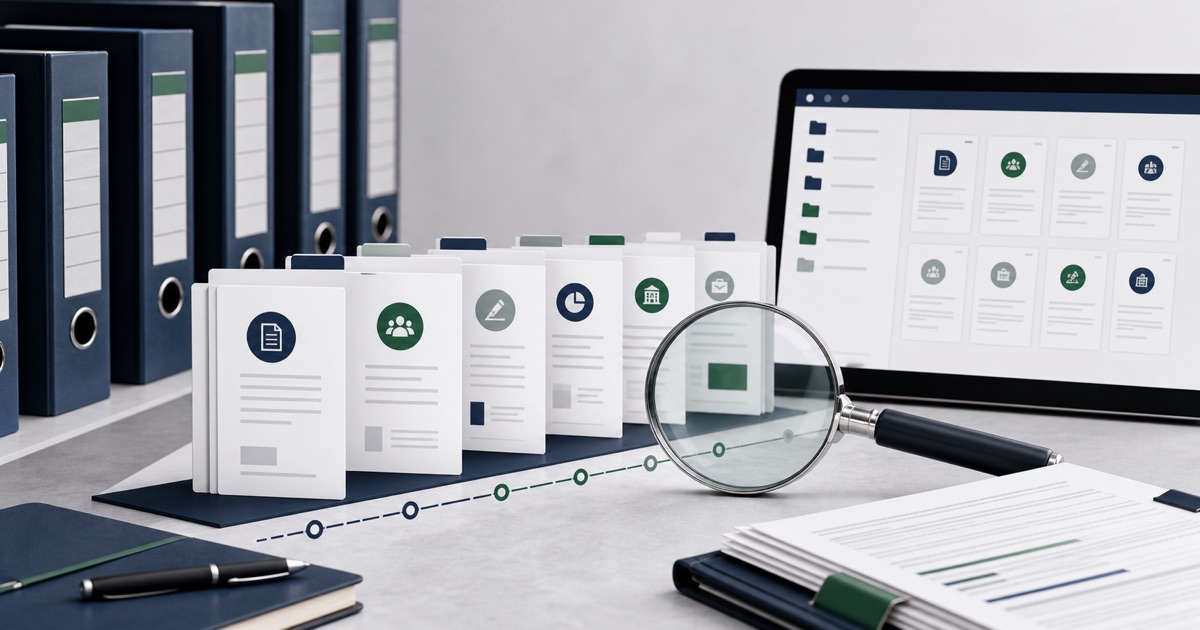
An Irish company’s CRO filing history is a dated record of documents delivered throughout its legal life. It can show annual returns, accounts, officer and address changes, share events, charges, resolutions and strike-off activity. The useful insight comes from reading those filings as a sequence—not from treating one form as the whole story.
Quick method
Confirm the company by CRO number, scan the history from newest to oldest, identify each form, separate its effective date from its filing date, and open the source document when the event matters to your decision.
Search the correct Irish company
Begin with the legal company name or CRO registration number. Trading names can differ from the incorporated entity, while several companies can have similar names. Match the CRO number, registered office and incorporation details before interpreting any filing.
What is a CRO filing history?
The Companies Registration Office maintains the statutory register of Irish companies. Documents filed with the CRO create a chronology of formal events. The history is not a diary of everything that happened inside the business: it records events for which a form or document was delivered under the applicable company-law rules.
A filing entry can contain several relevant dates:
- effective date: when the underlying change took effect;
- annual return date: the date to which a B1 snapshot was made up;
- financial period end: the last date covered by attached accounts;
- received or submission date: when the CRO received the filing;
- registered date: when the filing was accepted onto the register.
These dates can differ. A director can cease on one date and the related form can be filed later. Accounts submitted this year can cover a financial period that ended last year.
How to review a filing history step by step
- Verify identity. Confirm the legal name and CRO number.
- Check the current status. Note whether it is Normal, Strike-Off Listed, Struck Off, Liquidation or another official status.
- Read the newest events first. Recent status, officer and address changes may affect an immediate decision.
- Build the annual-return sequence. Look for consecutive B1 returns and identify the financial statements attached where required.
- Group related filings. A charge and its later satisfaction, or an appointment and later cessation, should be read together.
- Open material documents. A filing description cannot replace the actual accounts, resolution, charge or notice.
- Cross-check current evidence. Public filings are historical and may not reflect events that have not yet been filed or registered.
Common CRO forms in a company history
| Form or record | What it generally records | What to check |
|---|---|---|
| A1 | Company incorporation and initial particulars | Original name, officers, address and constitution-related details |
| B1 | Annual return and, where required, financial statements | ARD, period covered, filing timing and attached accounts |
| B2 | Change of registered office | Effective date and whether correspondence used the correct address |
| B10 | Director or secretary appointment, cessation or changed particulars | Person, role and effective date |
| B5 | Return of allotments | Shares allotted and the surrounding ownership chronology |
| C1 / C1A / C1B | Registration of a mortgage or charge | Charge holder, secured property and later satisfaction filings |
| C6 / C7 | Full or partial satisfaction of a registered charge | Whether the entire charge or only specified property was released |
| G1 / G2 | Special or other resolutions delivered for registration | The actual resolution and its legal effect |
| H15 | Application for voluntary strike-off | Whether the process continued, was stopped or completed |
This is not an exhaustive list. The official CRO forms directory provides the current form descriptions and statutory references.
How to read annual returns and accounts
Form B1 is an annual snapshot of prescribed company particulars. The CRO states that every Irish company, whether trading or not, must deliver an annual return at least once each year. For most companies, financial statements are attached where required.
There is a critical exception: the first annual return is due six months after incorporation and must not include financial statements. Later B1 filings should be reviewed alongside the period end of their attached accounts. Use our guides to check the latest Irish company accounts and understand which accounts are public.
How to interpret director and secretary filings
A B10 can record an appointment, cessation or change in particulars of a director or secretary. The effective date matters more than the order in which two forms happen to appear on screen. A burst of officer changes is not proof of wrongdoing, but it may justify asking why the governance team changed—especially around a major transaction, late filings or financial difficulty.
Do not infer ownership from a directorship. Directors manage the company; shareholders or members hold ownership interests. Our separate guide explains how to research Irish company shareholders and beneficial owners within the limits of public access.
How to interpret registered charges
Charge filings can show that security was registered over company property or assets. This is common in legitimate financing and does not by itself establish financial distress. Read the original registration with any later C6 full satisfaction or C7 partial satisfaction.
A CRO charge normally does not provide a live loan balance or prove whether repayments are current. Our guide to Irish company charges and mortgages explains the limitations in detail.
Patterns worth investigating
A single filing rarely tells the complete story. Look for combinations such as:
- gaps or repeated lateness in the annual-return sequence;
- accounts covering unexpectedly old or irregular periods;
- multiple officer or registered-office changes in a short period;
- new charges followed by no visible satisfaction where one was expected;
- strike-off notices followed by corrective filings or restoration activity;
- forms whose effective dates do not match information supplied by the business.
A pattern is a reason to ask a better question—not a licence to allege misconduct, insolvency or common ownership.
What the filing history cannot prove
Even a complete-looking record does not prove:
- that the company is currently trading or has employees;
- that it has enough cash to pay you;
- that every invoice, tax return or licence is current;
- that its directors, shareholders or related businesses have no disputes;
- that no material event occurred after the latest filing date.
For a material transaction, combine public filings with current financial information, references, contract checks and advice proportionate to the risk.
Businesses.ie versus CRO CORE
Businesses.ie helps you find and read an Irish company profile quickly. CRO CORE is the authoritative system for the official register and document image. Use Businesses.ie for discovery and context; use CORE when you require the original filing, a certified document or confirmation for a formal process.
Turn the filing trail into a practical company check
Order a Businesses.ie company report to consolidate available registration, status, officer, filing and financial information. Obtain official source documents from CRO CORE whenever the underlying filing is material.
Official sources and review note
This guide was reviewed on 4 August 2026 against the CRO pages for using CRO services, annual-return filing, the forms directory and the current company fee schedule. It is general information, not legal, accounting or investment advice.