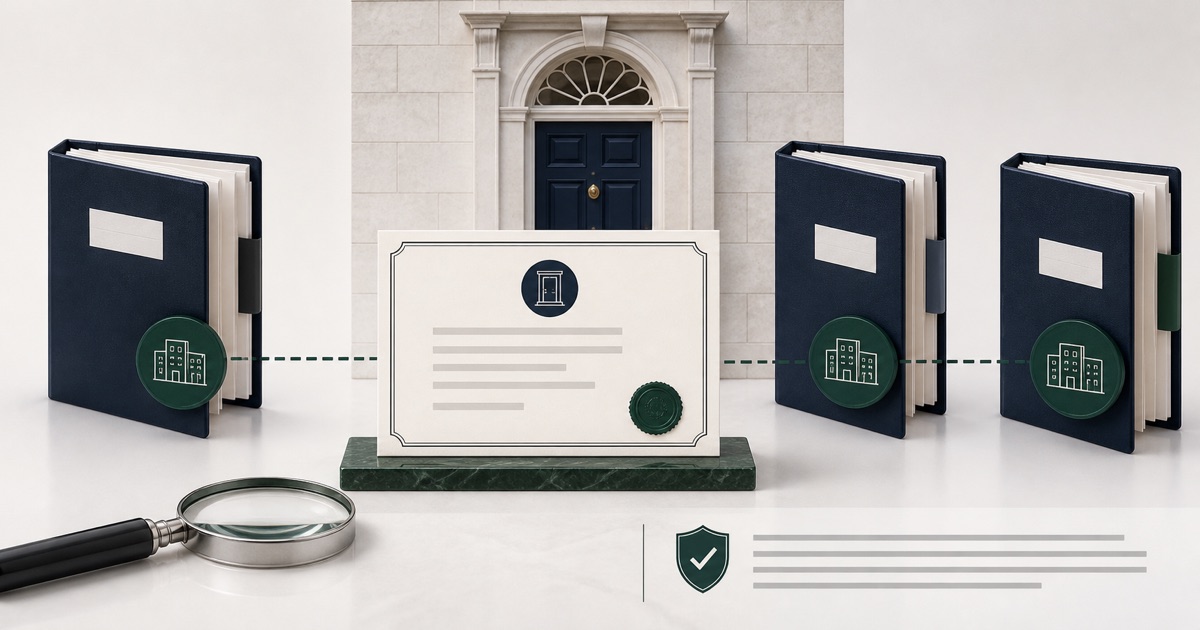
Yes, you can use a registered office address to research Irish company records. But an address is a legal correspondence point, not a reliable shortcut to ownership, trading activity or a shared business group.
Use address results as leads, not conclusions
A shared registered office can be used by unrelated clients of a Registered Office Agent, accountant or solicitor. Verify directors, ownership filings, company history and current evidence before describing companies as connected.
Search the company record first
If you know a company name or CRO number, open its profile and confirm the registered office. From there, investigate other records at the same address carefully.
What is a registered office?
The CRO defines the registered office as the address to which its correspondence and all formal legal notices addressed to the company are sent. Every Irish company must maintain one in the State. It must be a physical location capable of receiving post, not simply a P.O. box.
That does not mean it is where the company trades. A business may operate from another office, shop, construction site, warehouse or home while retaining a separate statutory address.
How to research companies at an address
- Write the address exactly as recorded, including unit, building and Eircode where available.
- Check the target company’s legal name, CRO number and status.
- Search available public company/address records for other matches.
- Open each company separately and compare its officers, incorporation date, filings and status.
- Review B2 filings to see when the registered office changed.
- Only describe a connection where supporting evidence exists beyond the address.
| Address pattern | Possible explanation | What it does not prove |
|---|---|---|
| Many companies at one address | Registered Office Agent or professional-services address | Common ownership or group structure |
| Same address and directors | May justify further research | That all companies share assets or liabilities |
| Recent B2 address change | Formal statutory-address update | That operations relocated on that date |
| Address on invoice differs from CRO | Could be a trading or branch location | That the invoice is fraudulent |
Registered office versus trading address
The distinction matters in supplier checks and debt recovery. The registered office is the statutory point for CRO correspondence and formal notices. The trading address is where commercial activity may take place. The principal place where company registers are kept can also be different again.
Do not visit, contact or serve documents based solely on an address search without understanding the purpose and legal requirements. For formal service or litigation, obtain legal advice.
Why many companies can share one address
CRO permits a company’s registered office to be in the care of an authorised Registered Office Agent. Professional firms may also provide administrative addresses. This is routine and does not mean every client company is managed together or even operates in the same sector.
For a better connection check, combine the address with director appointments, name history, charge filings and public accounts. Read our guides to director-connected companies and previous company names.
How to verify an address before payment
- Match the contracting legal name and CRO number to the register.
- Check whether the address is registered office, delivery address or trading address.
- Independently confirm contact details rather than relying only on an invoice.
- Check recent B2 filings and company status.
- Use staged payments and verified bank details for material exposure.
Research the company behind an address
Search Irish company records free, then order a Businesses.ie report for available status, directors, filings and financial information in one review.
Official sources and review note
This guide was reviewed on 4 August 2026 against CRO guidance on the registered office, Form B2 and incorporation requirements, and register locations. It is general information, not legal advice.