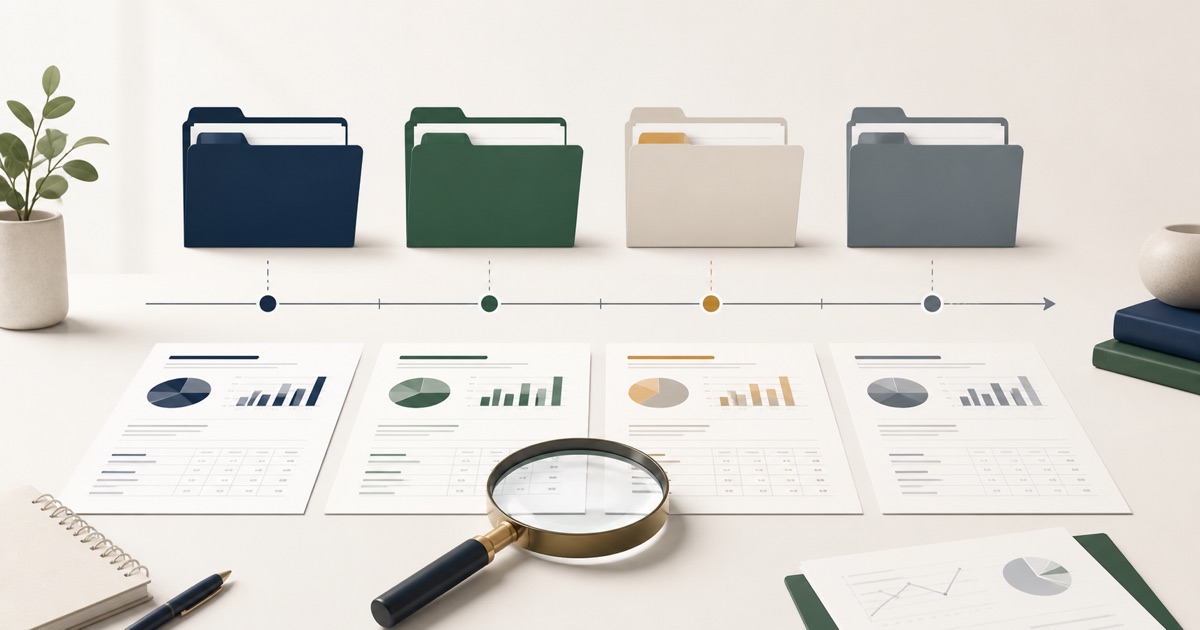
Public company records can help you understand how an Irish competitor is structured, when it was incorporated, what it has filed and what limited historical financial context is available. Use that information as disciplined market research—not as proof of private strategy, current trading performance, ownership or customer relationships.
Compare like with like
A useful comparison starts with the right legal entities, the same accounting period and the same public-document type. Avoid comparing one company’s current marketing claim with another company’s two-year-old abridged accounts.
Identify the correct legal company
Search the competitor’s legal name or CRO number. Brands and group names can be used by multiple companies, and the legal entity issuing invoices may differ from the entity shown on a website. Record the CRO number, company type, incorporation date and registered office before building any analysis.
Build a public-record research file
- Company identity. Capture legal name, CRO number, company type, incorporation date and registered office.
- Status and key notices. Check the current CRO status and any recorded strike-off, liquidation, receivership or examinership context.
- Filing chronology. Review annual returns, accounts, officer changes, address changes, resolutions and charges as a dated timeline.
- Financial context. Read the latest accounts period, comparative figures and notes actually available to the public.
- People and structure context. Note directors and secretary cautiously; a role does not prove ownership or a relationship between companies.
- Peer comparison. Use the same period and measure across each comparable legal entity.
- Source record. Keep links, dates and caveats so findings can be verified later.
Useful questions public filings can help answer
| Research question | Public-record starting point | Important limitation |
|---|---|---|
| How old is the legal company? | Incorporation date and CRO profile | Does not show when a brand entered a market |
| Has the registered office or officer group changed? | B2 and B10 chronology | Does not explain why a change occurred |
| What financial data is available? | Filed accounts and notes | May be abridged, historical and incomplete for comparison |
| Are charges recorded? | Charge filings and satisfaction history | Does not show current balances or every contractual obligation |
| Is there a status notice? | Company-status record and filings | Does not establish current commercial success or failure |
Read accounts as context, not a scoreboard
Accounts are historical documents prepared for a specific period. Some public accounts omit turnover, profit-and-loss or detailed cash-flow information. Compare the date first, then the disclosed measures and notes. Do not rank companies on a missing figure, and do not convert a balance-sheet snapshot into a statement about current sales or market share.
Use the financial-statements guide, negative net assets guide and abridged-account guide to interpret available filings responsibly.
Track changes over time
The real value often comes from a consistent timeline. Save the date and source for each company review, then compare updates rather than relying on memory. Watch for new filings, an accounts refresh, status changes, charge registrations or satisfactions, officer changes and address changes. A change can prompt a question; it does not itself establish motive or a commercial conclusion.
If marketplace presence is part of the comparison, use consistent measures rather than counting ads alone. Our guide to advertising an Irish business on LocalAds.ie explains listing quality, enquiry and conversion measures.
Use the research ethically and lawfully
- Use only information you are entitled to access and comply with applicable law and platform terms.
- Keep personal data to the minimum necessary and avoid speculative profiles of individuals.
- Do not present historical filed accounts as current financial performance.
- Do not make public comparative claims without verifying accuracy, context and legal requirements.
- Separate facts, reasonable inferences and unknowns in every internal briefing.
Turn research into a repeatable workflow
For a watchlist of competitors, standardise your fields: entity identity, latest accounts date, filing date, status, company type, charges, officer changes and research date. Review only at a sensible interval or after a material trigger. A Businesses.ie plan can support repeat public-record reviews, while CRO CORE remains the place to obtain official documents when required.
Create a consistent company research record
Search companies free, order an individual report for a structured review, or choose a plan for repeat research workflows across multiple Irish companies.
Sources and review note
This guide was reviewed on 4 August 2026 against CRO guidance on access to CRO data, financial statements and company officers. It is general information, not legal, financial or competition-law advice.