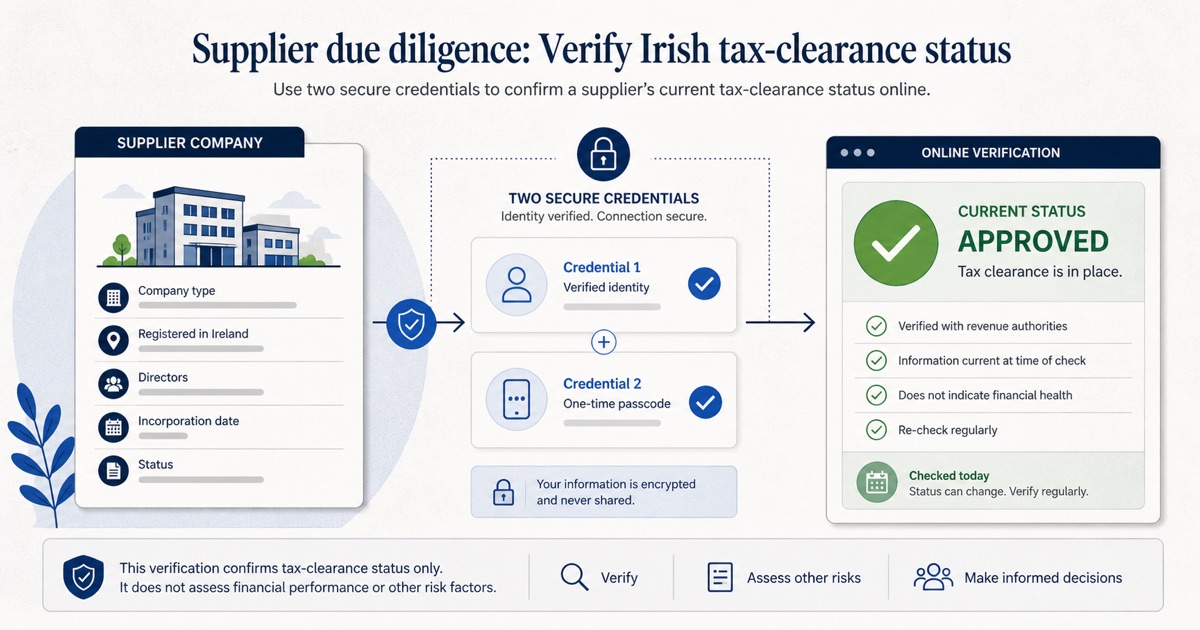
Revenue provides an online service that lets an authorised third party verify whether an Irish company or other taxpayer currently holds a Tax Clearance Certificate. The supplier gives the verifier its Tax Clearance Access Number (TCAN) together with its Tax Reference Number. A CRO number alone is not enough, and a printed certificate should not replace a current online check.
What is a Tax Clearance Certificate?
Revenue describes a Tax Clearance Certificate as confirmation that an applicant’s tax affairs are in order. Revenue may in some circumstances issue clearance where arrears are covered by an agreed instalment arrangement. The status can later be reviewed, refused or rescinded, which is why current verification matters.
What you need to verify a company
- the company’s exact legal name;
- its Tax Reference Number (TRN);
- its Tax Clearance Access Number (TCAN);
- your own authorised ROS access;
- a legitimate reason and the supplier’s permission to use the credentials;
- a record of when and by whom the verification was completed.
CRO number, TRN and TCAN are different
| Identifier | Issued/used by | Purpose |
|---|---|---|
| CRO number | Companies Registration Office | Identifies the incorporated company on the public register |
| Tax Reference Number | Revenue | Identifies the taxpayer for tax administration |
| TCAN | Revenue eTax Clearance | Allows an authorised third party to verify current clearance status with the TRN |
Confirm the supplier’s legal identity first
Match the legal name and CRO number to contracts, invoices and the company record before requesting tax-clearance credentials.
How to verify through ROS
- obtain the TCAN and TRN directly from the company through a trusted channel;
- confirm the legal company identity independently using the CRO record;
- sign in to Revenue Online Service;
- open the tax-clearance verification facility;
- enter the applicant’s TRN and TCAN exactly;
- review the live response and verification timestamp;
- save evidence in accordance with your procurement and data-protection policy;
- re-check at the decision or payment point if material time has passed.
Why a PDF or screenshot is not enough
Revenue does not print tax-clearance certificates, although an applicant can print or save its electronic result. A copied result shows what was displayed at a prior point in time and can be altered or become stale. The TCAN/TRN verification route provides a current status response and should be used where clearance matters.
What a successful verification proves
It supports the conclusion that the identified taxpayer currently holds a valid Tax Clearance Certificate at the time of the check. It does not establish that the person who emailed you is authorised, that bank details are genuine, or that the supplier can deliver a contract.
Combine it with the checks in our Irish supplier due-diligence checklist and contractor verification guide.
When tax clearance is commonly requested
Tax clearance is particularly relevant to public-sector contracts, grants, certain licences and other situations prescribed by law or policy. Private buyers may also request it under their onboarding rules. The correct requirement depends on the transaction; do not demand sensitive tax credentials without a legitimate basis and appropriate controls.
Data protection and security
- request credentials through a verified contact;
- limit access to procurement, finance or compliance staff who need it;
- do not publish or place TCAN/TRN values in an open tender file;
- store verification evidence only as long as policy and law require;
- never use credentials for an unrelated purpose;
- treat unexpected credential changes like bank-detail changes and verify independently.
Common mistakes
- using the CRO number instead of the TRN;
- accepting a screenshot without live verification;
- checking the wrong legal entity within a group;
- assuming clearance proves financial strength or no tax debt of any kind;
- keeping credentials in unsecured email or shared files;
- failing to record the verification date;
- not rechecking before a material award or payment.
Complete the company check
Use tax-clearance verification alongside CRO identity, status, officer, filing and financial checks—not instead of them.
View company reportsOfficial Revenue sources
Use Revenue’s live guidance for verifying tax-clearance status, tax clearance generally and eTax Clearance. This article is general information, not tax, procurement or legal advice.